

The Canadian Armed Forces are considering, at least on paper, a theoretical scenario of a military invasion by the United States and the country’s possible response to an attack by its neighbor and historical ally.
The study starts from a disturbing premise: In the event of a conventional attack from the south, Canada could barely hold out for a few days —one week, in the best of scenarios—against the American military power.
This is revealed by an analysis published by The Globe and Mail and confirmed by two senior Canadian Government officials, the Canadian Army develops a theoretical scheme that explores conflict scenarios.
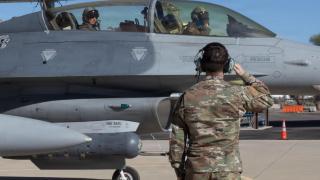
Canada does not have the number of military personnel or sophisticated equipment necessary to repel a conventional American attack, they said. The Canadian Army, which has a personnel of about 100,000 individuals, of which only about 68,000 are active and the rest are part of the reserve forces.
Therefore, military planners conclude that The only viable option would be an unconventional war based on guerrilla tactics, sabotage, ambushes, lightning attacks and the intensive use of drones.
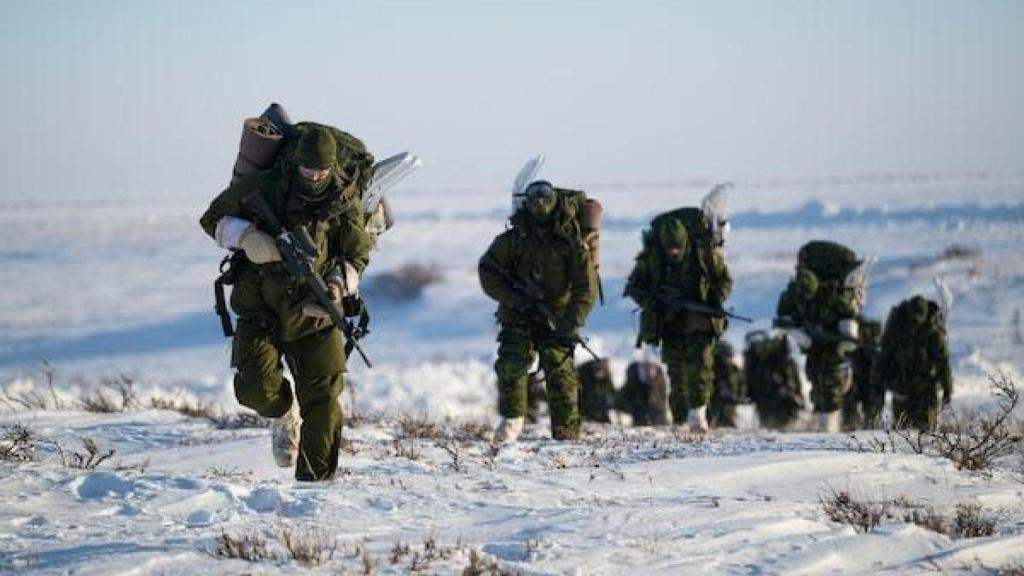
Canadian soldiers patrol the area around a NORAD satellite relay dome.
One of the officials explained that the model incorporates tactics used by the Afghan mujahideen against Soviet forces during the 1979-1989 war, and later by the Taliban against US-led troops during two decades of conflict.
This is a scenario Canada knows well: between 2001 and 2014, 158 Canadian soldiers died in Afghanistan, many of them victims of improvised explosive devices (IEDs).
The objective of this type of tactics, according to the analysis, would be inflict a high human and material cost on a hypothetical US occupation force.
The officials emphasize that they consider very unlikely that the president’s administration Donald Trump order an invasion of Canada.
They also emphasize that relations between both armies remain positive and that bilateral cooperation continues in key areas, such as Canadian participation in a new continental defense system – known as Golden Dome— against possible missile attacks Russia o China.
However, the political context fuels concern. Since his electoral victory in November 2024, Trump has repeatedly insisted on the idea that Canada could become the 51st state of the United States.
Canadian vulnerability in the Arctic
Furthermore, the chain NBC recently reported that the president has complained to his advisers about alleged Canadian vulnerability in the Arctic, a narrative similar to that used to justify his repeated calls for Washington to acquire Greenland.
In this framework, the former White House chief strategist Steve Bannon He went so far as to claim that Canada is “becoming hostile” toward the United States.
The military analysis also contemplates a possible collapse of the bilateral cooperation framework. Planners imagine that the first signs of an invasion would be the breakdown of joint defense agreements and the end of cooperation in the NORADthe binational command in charge of North American aerospace defense.
In that scenario, Canada would have a margin of just three months to prepare before a land and maritime offensive.
Mandatory conscription has been ruled out for now, but the debate about the level of sacrifice required of the population is on the table.
The Chief of the Defense Staff, General Jennie Carignanhas announced its intention to create a reserve force of more than 400,000 volunteers, who could be armed or activated in the event of foreign occupation.
The model also foresees the internationalization of the conflict. In the face of direct aggression, Ottawa would request support from United Kingdom y Francethe two nuclear-armed European powers with which Canada maintains deep historical, political and cultural ties.
The British monarch remains Canada’s constitutional head of state, while Quebec retains close ties to Paris.
military experts
Military experts agree that the scenario is extreme, but revealing. Retired Major General David Fraserwho commanded Canadian troops in Afghanistan, called it “unthinkable” that Canada had to contemplate such a scenario, although he acknowledged that drones and anti-tank weapons — similar to those used by Ukraine against Russia — could be used to slow down an invasion.
“There is no comparison between defending Kandahar and defending Windsor, Ontario,” he said, stressing that an incursion into Canadian territory would transform the conflict into an existential struggle.
Along the same lines, retired lieutenant general Mike Day recognized that Canada could not resist a conventional invasion, but he doubted the ability of the United States to occupy and control a country of Canadian territorial magnitude.
“Taking Ottawa would not mean the surrender of the country,” he warned, drawing parallels with the Ukrainian resistance after the fall of kyiv in the scenarios proposed by Moscow.
The truth is that beyond its real viability, the exercise reflects a profound transformation of the North American geopolitical environment, where even relations between traditional allies are no longer considered immune to the logic of rivalry and mistrust.
Leave a Reply