
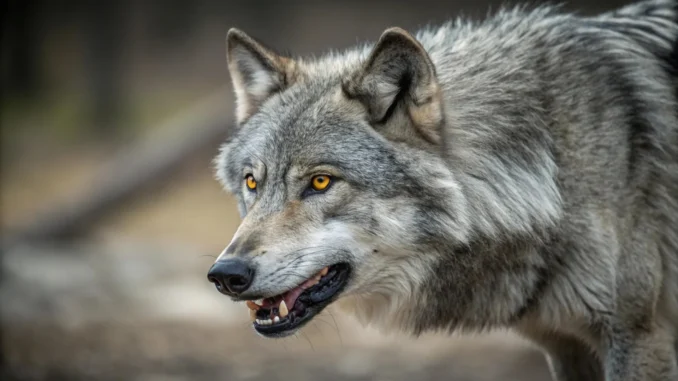
On Prince of Wales Island in Alaska, gray wolves are behaving in an unusual way: they are hunting sea otters. This unexpected shift in diet could have wide-ranging effects on coastal ecosystems and on wolves themselves. However, scientists still know very little about how these predators manage to capture prey in the marine environment. Patrick Bailey, Ph.D. candidate at the University of Rhode Island, is leading research on this little-studied behavior.
Using a creative mix of approaches—including wolf tooth samples and trail cameras—Bailey examines how coastal gray wolves rely on marine food sources, what this reveals about their hunting strategies, and how these wolves differ from inland populations.
Connecting terrestrial and oceanic ecosystems
Gray wolves are well known for their strong influence on terrestrial food webs, where they help regulate prey populations and shape ecosystems. Bailey believes that similar connections may exist between terrestrial and aquatic environments. “We don’t have a clear picture of the connections between water and terrestrial food webs, but we suspect they are much more widespread than previously understood,” says Bailey, who works in Sarah Kienle’s CEAL Lab in the Department of Natural Resources. “Because wolves can change terrestrial ecosystems so dramatically, it’s possible we’ll see similar patterns in aquatic habitats.”
Teeth tell a story
Sea otters, now classified as an endangered species, once thrived along the Pacific coast before the fur trade drastically reduced their numbers during western colonial expansion. As sea otter populations slowly recover, wolves may be restoring the predator-prey relationship that existed in the past. Scientists are now trying to find out how this interaction affects the behavior of the wolves and whether it affects the restoration of the sea.
To investigate these questions, Bailey analyzes gray wolf teeth from museum collections and recently deceased animals using stable isotope techniques. Like tree rings, teeth grow in layers that record changes over time. “If they are large enough, we can individually sample each of these growth rings to track an individual’s feeding patterns over time,” he explains. “Once we collect enough samples among individuals, we can analyze how prevalent these dietary trends are across the population.”
Kienle notes that hunting in the ocean presents very different challenges than hunting on land. “Capturing and eating prey in the marine environment is very different from that on land,” he says. “We are very curious if these coastal wolves have behavioral adaptations that differ from terrestrial wolves.”
Although there have been official reports of wolves eating aquatic prey for over 20 years, many details remain unknown. “What hasn’t been researched, and what I’m really interested in documenting, is how exactly wolves are able to catch sea otters,” says Bailey.
New technology brings a new perspective
Previous video footage of wolf hunts lacked the clarity needed for detailed study, but the newly installed cameras may finally provide the answers. These cameras were set up by Bailey on the island over the summer and are positioned to capture more detailed behavior. “So far we know that these wolves consume sea otters,” he says, “and now we’re ready to capture details that previously eluded us.” A team of seven University of Rhode Island students was trained to help evaluate more than 250,000 images of wolves and sea otters collected since last December.
Studying wolves in such conditions is not an easy task. Bailey points out that their intelligence and flighty nature make them difficult subjects, especially in a remote landscape. “When you combine these features with a landscape that is very rural and difficult to traverse, it becomes quite a challenging task to explore them,” he says.
Prince of Wales Island was chosen as the primary field site through a partnership with Alaska Department of Fish and Game biologist Gretchen Roffler and local research engineer Michael Kampnich. Bailey emphasizes their role in the success of the project. “I can’t stress enough how much these two have helped me,” she says. “This project would not have been possible without their input and guidance.”
In particular, Kampnich helped the research team understand the island’s ecology and terrain. “Kampnich was an incredible resource to introduce us to the island and its unique ecology,” adds Bailey. “Working with local residents is so important because they have decades of experience and perspectives that we as outside researchers just don’t have.”
Mercury risks move up the food chain
Roffler’s recent findings raise concerns about another consequence of sea fishing. Her research shows that sea otters can accumulate high levels of methylmercury, a toxic form of mercury. This raises the possibility that wolves feeding on otters may also be exposed. Liver samples from coastal gray wolves show mercury concentrations much higher than concentrations found in inland wolves – up to 278 times higher – which could pose serious long-term health risks. “The accumulation of methylmercury can cause a number of problems related to reproduction, body condition and behavioral abnormalities,” explains Bailey.
Expansion of research to the east
Although her current focus is on Alaska, Bailey hopes to expand her research in the future. Limited resources mean his work is focused on areas where data collection is most promising, but he plans to include the East Coast.
“I’m including historic East Coast wolves in a separate chapter of my dissertation comparing skull morphology between coastal and inland populations,” he says. He is currently studying skull specimens from parts of Canada, including Newfoundland and Labrador, provided by the Harvard Museum of Comparative Zoology.
For now, data collection is ongoing, with the research expected to continue for several more years. Bailey also plans to return to Prince of Wales Island next summer to continue field work.
Leave a Reply