
One year into President Donald J. Trump’s second term, NASA is reporting measurable gains in human spaceflight, scientific research, aviation and advanced technology development. Agency officials say these achievements signal the early stages of a renewed period of American leadership in space, supported by defined national priorities and major investments through the Working Families Tax Cut Act.
Since President Trump took office as the 47th President of the United States, NASA has refined its mission in line with his national space policy. This direction emphasized US leadership in space while accelerating progress in exploration, scientific discovery, and innovation. With an increased focus on human spaceflight, research excellence and national capabilities, the agency says its work is moving forward with renewed purpose.
Key space initiatives launched during first term
NASA’s recent momentum builds on actions taken during President Trump’s first term. During this period, the United States established the US Space Force, launched the Artemis Campaign, and created the Artemis Accords, which now include 60 participating nations and continue to expand. The administration also oversaw the return of U.S. astronauts to space from U.S. soil following the end of the space shuttle program.
With a formal national space policy and the Working Families Tax Cut Act now in place, NASA has the direction, funding and authority it says is necessary to carry out an ambitious long-term strategy.
Missions, aircraft, and expanding exploration efforts
During the first year of the president’s second term, NASA completed two human space missions and launched 15 science missions. The agency also successfully tested a new experimental X-plane. At the same time, work has accelerated across a range of priorities, including lunar exploration, Earth science, planetary defense, next-generation aviation, and technologies designed to support future missions to Mars.
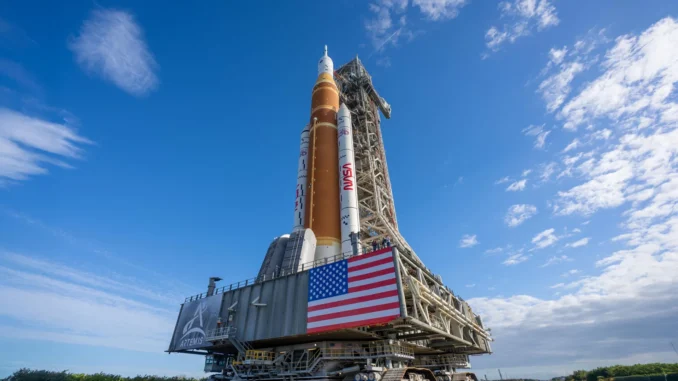
NASA is also gearing up for a big upcoming milestone. The agency plans to launch the Artemis II mission, which will send astronauts around the moon for the first time in more than 50 years. This flight is designed to prepare for a permanent American return to the lunar surface. Agency leaders say these achievements reflect a workforce encouraged to move quickly, pursue ambitious goals and achieve tangible results.
NASA’s guidance on direction and momentum
“In the first year of this administration, NASA has moved with clarity, purpose and momentum to advance President Trump’s bold vision for American leadership in space,” said NASA Administrator Jared Isaacman. “From strengthening our focus on human spaceflight and preparing for the first exploration of deep space by NASA astronauts in more than half a century to accelerating innovation across science, technology and national capabilities, the President has provided NASA with the clearest executive direction since the Kennedy era. President Trump’s National Space Policy has sharpened our mission, aligned our priorities, and enabled faster and more confident delivery of our workforce to the future of America’s space preeminence for generations to come.”
Plans for the Moon, science missions and deep space technology
NASA officials say the agency is well positioned to continue building on its recent progress. Under President Trump’s leadership, US astronauts are expected to return to the moon by 2028 and begin building a long-term human presence supported by a lunar base. NASA will also continue to launch science and discovery missions, including the commissioning of Rome’s Nancy Grace Space Telescope by the end of the year.
To support future deep space exploration, the agency is improving nuclear power and propulsion technologies designed to expand the mission’s capabilities and enable travel further into the solar system.
With a clearly defined mission, a motivated workforce, and strong partnerships with industry and international allies, NASA enters the second year of President Trump’s second term focused on expanding America’s leadership in space and pursuing discoveries that could shape humanity’s future for decades to come.
Leave a Reply