
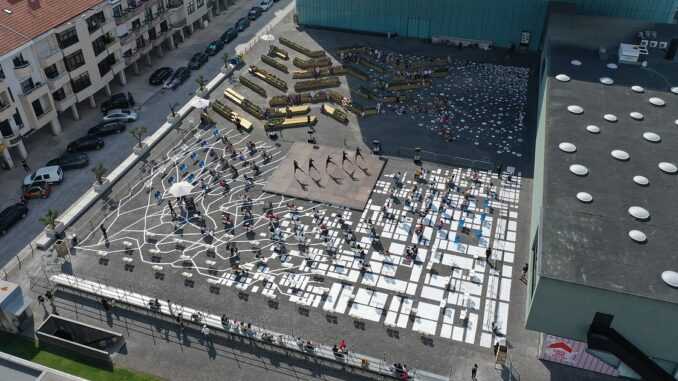
Art in public space I try to explore the expression of Portuguese cities, mostly to revive historic centers and attract tourists. It is a sector that involves many different actors, including artists, promoters and cultural and cultural programmers. To bring all these parts together and contribute to the dissemination of best practices in this area, in 2016 the Outdoor Arts Portugal platform created a project supported by Bússola, a specialized structure for the planning, financing and implementation of artistic and creative projects. placemaking that the launch or book When we know we are on the street where we want to meet – Art in public space and placemakingfinancial project for DGArtes.
“We realized that there was a need to deal with this very specific sector, which in Portugal is called ‘street art’, which often has a negative connotation and which is not strategic, it is just a street palace or street musicians, but it has never been more. This evolving process, there was a need to unify the sector, create conditions for professional development, e.g. capacity, training, international communication of artists and in 2016 it should have been this year, the creation of Outdoor Arts Portugal“, explains Bruno Costa, the coordinator, together with Daniel Vilar from the book.
This publication follows another book, Manual of practical steps for organizing artistic events in public space, launched in 2021. “Several municipalities have already used it, it has already been referred to a lot in public competitions for the selection of municipal technicians in cultural areas and We felt that we are at a moment when we are questioning the sector of a more lively form and that this form could be more cross-sectoral and connect us with other dimensions such as urbanism, or if it were, how art could effectively contribute to the development of the city.”says Bruno Costa.
When we know we are on the street where we want to meet – Art in public space and placemaking gathered perspectives from different geographies, Portugal, UK, Spain, EUA and Canada, drawing on contributions from professionals with expertise in urbanism, curation and cultural management, named after Charles Landry, Ramon Marrades, Tiago Mota Saraiva, Jamie Bennett, Karine Décorne, Sud Basu, Rachel Clare, Luís Sousa Ferreira and others Bruno Costa and Daniel Vilar. And because it claims to be useful for working in the sector, it includes a 14-step guide to help you placemaking through art.
But what is it? placemakinga concept that is understood in a limited form in Portugal, think Bruno Costa and Daniel Vilar. “Fever.” placemaking I try to appear in Mexico in Portugal in a form closely related to urbanism, architecture and in some cases risks becoming an urban decoration. We are not wrong, but we are asking to find the same form of another form, or placemaking connected with theater art, because scenic art has the effect of transforming public space into a place of well-being, a place of symbolism, more focused on people, on traditions, on memories, on creating places of existence, participation and life, and not just places of passage,” explains Daniel Vilar.
“This book was created to combat this perspective that must return to cities every time it is published, with most events people attend but not for the people who are there and always focus on who visits and not who dies. For example, the history center nerd many times does not know what the purpose is in the event criterion, which leads him to not be limited in connection with the entire entity,” he adds.
Or a thermos placemaking Let’s look at our United States and we have the appropriateness of the word for “commercial urbanism”, consider. “But what do we ascribe to ourselves and therefore point to the original definitions placemakingI am afraid to implement the idea of transferring urban development to the community. For example, moving from what constitutes a municipal camera in the Portuguese context to a transformation of practice. If you, the president who decided to transform, but do not carry out the process in the municipality, encourage the community to actively participate in the same space, it is an architectural prism”, Bruno Costa is an example. This way “we can use techniques that are completely connected to participatory art to create more things in this context of transforming space and returning to things more human.”
For these processes to result, there are elements that require you to be aligned: “The municipal chamber is of great importance because everything is part of the municipal policy, then the mediator who is the mediator, the entity that goes to make the game between the institution and the communities, and then the communities within them,” said Daniel Vilar.
A good example of community evolution in the definition of public space is primarily a project Planteiaintervention next month at the Casa da Cultura de Ílhavo supported for 23 monthsthe cultural project of this municipality, which transformed the space with the moradores of the area and created a garden with canteiros, with corn of two hundred plants.
“When the municipality built the Casa da Cultura de Ilhavo, it created an external space, without life, considering that it was necessary to create life and or placemakingwith your hardware, adapt to each location, you can use hardware from urban, artistic and other disciplines that will transform the space into a single place. And we say that we are transformed into a place where we get life, life and experience on a human scale”, says Daniel Vilar.
O public-alvo de When we know where we are, where we want to meet – Art in public space and placemaking, tell us book coordinators they are political agents as well as people associated with urban planning designand also artists who work in public space.
To ensure that public art is not external, we must defend ourselves by reaching out to the community, understanding the spaces, and promoting, as the author, “active territorial advocacy.”
“And we believe that many authors will be absolutely clear about this, because reaching the public is part of the artistic goal. Sometimes this is an institutional step, including an intermediate step that may not represent a large number of customers. When the author elaborates or understands the space, makes a technical visit, among people or promotes a meeting to perceive how we understand the space, let’s go to a new room, decorative or symbolic, and the eagle that means to us and helps us build a community”, underlines Bruno Costa.
And many times, says Daniel Vilar, “it is precisely these processes of community that give voice to the many tensions that exist in places that are otherwise not clear and reflective. Many times these artistic expressions are captured by the voice of those who live in that place and return almost as symbolic and emblematic forms of expression of tension”.
We are advocating for the creation of synergies in the city chambers in the field of urbanism and culture, because the structures of the municipalities are “highly segmented”. “To the detriment of the separation of culture and the separation of urbanism isolated such as these structures, because it is possible to create synergies and cultural decorations contribute to urbanism, and the map of urbanism, if for example with artistic agents, also contributes to cultural media”, suggested Bruno Costa. Consider that the goal is to “maximize resources and create interdepartmental synergies. How do we achieve balance and synergy with resources that are always limited. From this book we are guided as we work in urban planning, as politicians, as culture,” he notes.
Oh book When we know we are on the street where we want to meet – Art in public space and placemaking It is available in all public libraries and is available. online free em www.outdoorarts.pt.
Leave a Reply